
CAMBRIDGE, NEW YORK — JULY 1980
Meaghan’s mornings had a sound.
Not always the same sound — it changed from day to day, showing up before she was fully awake, in the space between sleep and getting up that she’d never been able to close off. Today it was something in D minor that she didn’t have a name for, sitting in her chest like something that wanted to resolve and wasn’t going to.
She made coffee. She walked to work. She was the town librarian at the Cambridge Public Library, which was a title that somewhat overstated the staffing situation. She was also, by her own reckoning and nobody’s appointment, the town historian. Every library holds some history. A small town’s library is the only vault it has.
She came up the front steps looking down into her work bag. The library keys lived in a pocket inside it — a set, not a key, every shape and size and age of key, metal from a lot of different years on one ring.
She tripped.
She looked down.
A basket. One of the big deep ones, the old New England kind with the swing handle, oval and splint-woven and wide enough across that a person would have needed both arms and a plan to get it up those steps in the first place. Inside it, packed down into the bottom, five puppies, asleep in the total way that only very young things manage — not resting, not dozing, but gone, laid out against each other with no daylight between them.
Meaghan stood over it.
The feeling arrived on schedule. It was warm and it was uncomplicated and it lasted about four seconds, which was as long as it took the rest of her to come online, and then it was replaced by a different thing entirely, which was the beginning of a list.
She looked up and down the street. Nobody. She looked at the basket. She looked at the door. She found the right key on the ring, put it in and turned it, and hefted the big door open.
She took the basket by the rim with both hands and pulled. It came, heavier than it looked, over the boards of the landing. She eased it over the threshold with a short rumble, and on the smooth floor inside it went to a hiss. Then she kept going, stepping backward, bent, one hand on the rim now and one on the handle, until she was standing more or less in the middle of the library.
She stopped. Where next? She closed her eyes and took a deep breath and let it out.
The back storage room. One door. No public access. Concrete-slab cool even in July. And stacks — waist-high stacks — of bound newspapers three months dead and bound for recycling, which she had been meaning to deal with for a month and had not, and which as of this morning became the single most useful thing in the county.
She broke the bundles out and laid the sheets down in a wide flat field. She built the walls out of the stacks themselves, a soft-sided square about five feet on a side, high enough not to be climbed and low enough for her to step over. She slid the basket in, tipped it gently onto its side, and let them come out on their own, which they did in a slow uncoordinated tide, without ever fully waking. She put down a saucer of water. She stood at the door for a minute and watched, and nothing went wrong, and she let herself accept that nothing was going to go wrong before she had a plan.
Stabilized.
Now the rest of the morning.
She went out to the desk and picked up the phone.
The line picked up on the second ring.
“Good morning again,” Meaghan said.
There was a pause on the other end — not long, but there.
“Well, good morning again to you. Now, did I let you get out the door without something?”
“No — no. Nothing like that. Something new. Something that turned up this morning.” She turned the pencil over on the blotter. “A surprise. A basket of sleeping puppies.”
“Puppies?”
“On the front steps of the library. Just there, in a basket. I’ve got them sorted for now — they’re in the back room, they’ve got water, they’re all asleep. It’s fine. It’s the next part I don’t have.”
“How many?”
“Five.”
“Five.”
“Quite a load,” Meaghan said.
“I’m on my way.”
“No — please —” and it came out faster than she meant it to, and she had to slow herself down. “You have your meeting. The historical society, this morning. You’ve been three weeks getting those people into one room at the same time and you know perfectly well what happens if you’re not in it.”
“Meaghan.”
“They’re asleep, LL. Every one of them. They haven’t so much as —” and here she stopped.
What she had said was true. Meaghan did not lie, and a fib needed a reason she did not have. The second truth, the one she did not say, was that she wanted them here. For the morning. In the back room of her own library where she could go and stand in the doorway between things and look at them, which she had already done once and intended to do again, and which was nobody’s business and served no purpose whatsoever.
“Yes — yes, dear, you’re right, but —”
“We’re fine. Really.”
“I’ll be there at eleven,” LL said, in the voice she used when the discussion had concluded. “Together we can load them up and bring them back here, and we’ll map out a remedy for this surprise over lunch.”
Meaghan opened her mouth.
“Eleven. I’ll see you and your puppies then,” said LL, and hung up.
Brother Robert had the radio on. He had it up louder than he usually ran it, and the signal came and went with the hills. He was humming along. He did not usually hum.
Sunday morning he had woken with a line in his head. It had started out as today is the first day of the rest of your life. He could not have said where he first heard it. After he started with the dogs it became his own: Every day is the first day, to a dog. It came at New Year’s and on his birthday. It also came at times that had nothing to do with anything, and sometimes after whatever it was for had already been seen to. He had wondered, for about a second, why now. Then he had gone and got the clipboard.
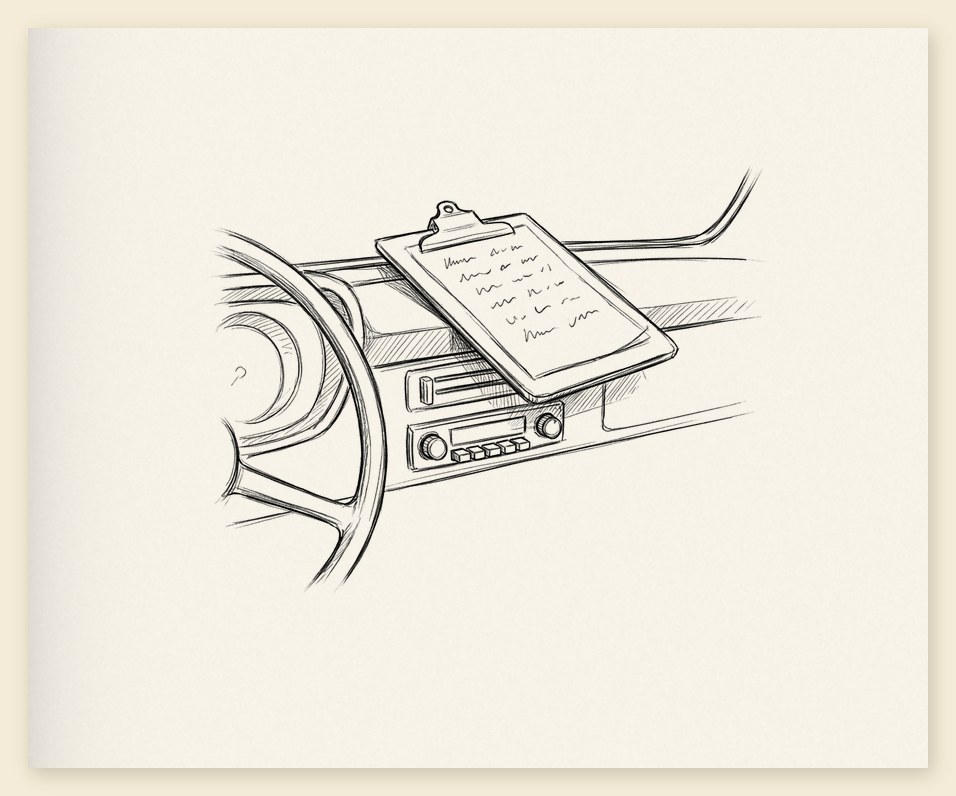
The clipboard rode on the dash with Monday’s sheet on top. He had built it Sunday night — one sheet for each bucket and a master sheet over them — and the last thing he had done was put a time of day against every line. Some weeks the times did not add up, and he pulled a clean sheet and started over. This week they had added up the first time through. The market was the first stop on the sheet. There were others after it.
The house was short that week. The abbot was away, as were two brothers, and Robert’s usual Monday partner into town was one of the two. That left the provisioning to Robert alone, which meant the cart and the list. There was no litter in the kennels. The last one had gone easy, and there was nothing behind it yet.
The abbot’s absence was the one he had thought about. Basil made the large decisions. When a decision was Robert’s and Robert wanted counsel on it, Basil’s office was where he took it. Robert did not see anything of that kind coming this week.
The summer he was fifteen his parents had gone away for a weekend and left him and his brother, who was seventeen, in the house. No grandparents. Two nights. The two of them had made plans for it, and some of the plans were on the optimistic side. Before the car left the driveway their father had laid down the rules, and then their mother had laid down hers. The brothers cut the list after that. What was left was still a good two days. Their parents came home to a house with nothing wrong in it, and their mother in particular was glad of that for a long time afterward. For years the two of them had argued over which one deserved the credit for cutting the risky business off the list — who had argued for taking what off, and who had held out for keeping what.
The radio dropped out on the hill above town and came back at the bottom.
At the market he worked off a large flat cart, because the list for the house was not a basket-sized list. Mondays the market turned commercial — the weekend browsers gone, the growers selling in quantity to restaurant buyers and the corner markets in from a wider circle than Cambridge. He worked it the way he worked most things — in the same order as last week, which had been the same order as the week before with slight changes with the seasons. The list was lighter than usual and the cart filled anyway. By half past the hour he had stopped checking the list.
He looked at his watch. He had a few minutes.
There was a stand at the far end that he had never taken the time to look at. It had been there a few weeks — a grower who ran to odd stuff, things without familiar names, some of it Asian — and every Monday Robert had walked past it at the pace of a man with a list. He rolled the cart over.
A man was already at the tables, examining the produce. Not browsing — examining. He picked a thing up, turned it, brought it close to his face, set it down exactly where it had been, and took up the next one. Long pods, curled like something that had grown wrong on purpose. A basket of something green and warty, the size of cucumbers.
The vendor was not around.
Robert picked up a few things himself. By the third one he had more questions than he had come with. The vendor was still nowhere, and he decided to push his luck. He held one up — one of the long pods, longer than his hand — and asked the man.
“Excuse me — would you happen to know anything about these?”
The man looked at the pod, and then Robert had his answer, and kept having it. What it was — a yardlong bean. What family it belonged to, by the Latin.
“Vigna unguiculata,” the man said. “Sesquipedalis.” He said the last word again, slower, and then a third time, and the third time was the one.
Then the two dishes it most often went into, one quick and one slow, and what went alongside each, and for the slow one, what you poured.
Robert reached into his cart and came up with a head of lettuce.
“What do you make of this? The lettuce didn’t look so hot today. That was the best I could find.”
The man took it, turned it, and looked at the cut end.
“It’ll keep. Wrap it wet.”
Robert looked at the lettuce, and at the man.
“How do you know so much? Are you a chef?”
“Oh, I’ve spent some time in kitchens over the years. A galley or two. New Orleans to Calcutta.” The man picked up one of the warty green things. “Bitter melon. These, now — these you have to watch out for. They can put the hammer down and take over the whole dish if you don’t watch ’em.”
“Sounds interesting,” Robert said. “Do you work at one of the restaurants here in Cambridge?”
“No.” The man set it down where it had been. “But just thinking — know of any that might need a cook?”
“I don’t,” Robert said. “You could try the places along Main. The hotel might be worth a try.”
“Thanks. Covered the places that were open this morning. Planning another pass later today. The hotel’s out, though, for sure. Tried to work a little room-and-board trade there. No go. She was loud and clear about it, too.”
Robert knew of the woman who ran the hotel.
“Yes, well. I’m sorry about that. I hope you have better luck this afternoon.”
He pushed the cart off. He got a few feet and stopped, and turned around.
“I’ll check around for you. Where can I get hold of you?”
“Oh, around town.”
—
Robert found himself driving back toward the monastery with everything on his provisions list, and then some.
The man’s name was Carl. It turned out he had missed getting back on the northbound bus — not that morning; the day before — and had spent the night on a bench in the gazebo off West Main. He was in need. Simple as that.
The truck was a Ford Courier, a small one — a four-cylinder the house had bought used when gas went up, for the mileage — yellow, the long-bed, which gave it a strange stretched proportion. It was dinged down both flanks and shifted with a stick. Carl folded into the passenger seat with his hat just grazing the headliner and looked satisfied with it.
The first tinge of the day came as they turned onto the road out. Where was he going to put him? The abbot being away cut both ways. It gave Robert time. It also meant nobody could clear a stranger to stay on the grounds — the grounds proper, anyway. He let the truck roll to a stop. He sat with his eyes on nothing in particular. Then the overgrown turn-off came into focus. He put the truck in gear and took it, and as the front wheels left the pavement the second tinge came. He had not been inside the cabin in a couple of years at least, and it had been in bad shape then.
He slowed, and started apologizing.
He apologized the rest of the way down the loose, gravelly, rutted track, across the clearing, and was still apologizing when they reached the cabin — for the state of it, for the distance, for the arrangement being what it was, which was temporary, which he would sort out, which required only a day or two of discretion while he figured certain things concerning the abbot.
Carl was Carl. He looked at the cabin the way he looked at things.
It was an old hunter’s cabin, one window and a Dutch door, the door’s upper half carrying four small lights of glass, gray wood that had never in its life met paint, with a stoop just deep enough to hold a three-legged stool, if a man had one. Robert took the knob and pulled, and the door held. He pulled harder. The door held harder.
Carl stepped past him, took the knob in both hands, and lifted — up and out, one motion, unhurried, the way you’d help an old man out of a chair — and the door came open outward with a sigh and a fall of dust. He ducked his head and stepped through. Robert followed, and ducked too, the dust still coming down.
Everything inside was lower than it should have been, as if the hunter who built it had been economical, or small, or both. A double bunk built into one corner. A bank of cabinets with a wood counter in another. A low potbelly stove in the third, its pipe elbowing out through the wall. The fourth corner stood open, and near the floor of it was a hole that had nothing to do with any carpenter.
Carl moved through the room picking things up — implements off their nails, a stacked box, a stub of candle — turning each one over, setting each one down again, not always where it had been. He unhooked the upper half of the door. It was finicky. He got it swung back to the outside wall, and it stayed there. Robert talked. About the food and water he’d bring, and bedding, and a lamp, and whatever else, and about the necessary discretion — “just until I can figure things out. I’m sorry about the mess. It shouldn’t be too long. Okay?”
Carl set a box down in front of the hole in the open corner, squared it with his boot, and looked around the room once, all the way around.
“Oh, I think it’s nice,” he said. “Just a little work here and there.”
Meaghan looked in on them again. They had spread out. Two were on their backs, pink-and-white bellies up. She had the start of a count — not of them; of what they were — and she stood in the doorway and worked at it: a white toe here, a darker saddle there, two shapes of head. She had meant it to be a quick look, like the first two. She caught herself. There was work to do, and the sign to flip at eleven.
The newspapers went onto the reading sticks — the big city papers first, the Times, then the Tribune and the Los Angeles Times, then the regionals, then the local. Loading the Tribune onto its stick she half-registered a photograph below the fold. Three of them. A man in a judge’s robe, looking official. A golf fairway torn up badly enough that her first thought was whether anyone had been hurt. The headline said nothing about anyone hurt, or worse, and the thought went cold. And a third she didn’t stop on, because she had work to do — except that something about it stayed with her after she’d moved on, the way a face does when you’ve seen it somewhere recent. She catalogued three returns. She checked the overdue list against the stack of cards one last time, stamped each one, and set the stack in the outgoing tray. In between she went back twice more, and kept it short.
At eleven, on the minute, LL came through the front door of the Cambridge Public Library, and Meaghan walked her back through the stacks without a word and opened the storage-room door.
LL looked at the newspaper walls. She looked at the five of them, spread out now across the floor of it.
“Found some friends — and they’ve been sleeping all this time?”
“Yes. I’m guessing our luck is going to run out pretty soon. They’re going to be looking for breakfast.” Meaghan pointed. “That one there, on his back. He’s been chasing something for a while now.”
The pup’s legs were going, all four stubs of them. Then a front paw — a fat one — came up and swept an arc in the air big enough to carry him over onto his side.
“We’d better get moving,” LL said.
They got the puppies back into the basket. They each took a handle and lifted, and set it down again, and did what Meaghan had done that morning — slid it, one on each side, across the floor, through the stacks, to the front door.
“Now the hard part,” Meaghan said.
The hard part was the steps. They took a handle each and carried it down to the Suburban at the curb with some effort and no grace. LL went around to the back, put the key in the tailgate, turned it and held it until the window was down, and dropped the gate. They hefted the basket up onto it. Meaghan climbed in and pulled the basket into the way back.
She went back into the library for a bundle of the papers and her bag — the keys were in it — and on the way out she turned the card in the front door window. CLOSED, and the little cardboard clock hands set to a time she chose without much conviction. She could not remember the last weekday she had done it, and she declined to stand there and work out how long it had been. She locked up.
LL drove them back to West Main, stopping at the general store for puppy food.
At LL’s the first order of business was the guests. LL had raised most every kind of young thing on that property, and whatever she hadn’t raised there she had raised on the farm, and she had had a plan fifteen minutes after she set the receiver back in its cradle that morning. A corral went up on the big front porch. Paper went down. The puppies came out of the basket and went onto the front lawn in pairs, and came back in. Then the bowls, food and water. Only when they had eaten and gone drowsy did the two women sit down to their own lunch, at the small table and chairs on the porch.
They talked about the Historical Society meeting and what had been agreed upon, and what — or maybe who — needed “a little time,” as LL put it. The garden came up as LL was clearing the plates. The rodent problem, specifically. The one in the second bed, where something had been undermining the bulb plantings two seasons running. Meaghan listened as well as she could. They both had other fish to fry.
“We’ll find a solution,” LL said. “Just not today. Now — let’s talk about these pups.”
“We should call the monks at New Skete,” she said. “Better yet, I’ll call Father Basil. He’ll have a handle on what’s going on with their kennels.”
Father Basil had a reputation for having a handle on things.
“Yes — I mean no,” Meaghan said. “I’ll call Father Basil. If it doesn’t work out, maybe you can pitch in. Pitch in again, I mean.”
She found the number and called.
The telephone rang, and kept ringing.
Brother Robert was not supposed to be answering it. The abbot was away at a conference. The man who usually answered — Brother James, who had a gift for administrative tasks and, unlike Robert, liked them — was dealing with the community’s septic system and a subcontractor who had not shown up. Brother Cass, who might have answered, was visiting his brother in the Chicago area.
Brother Robert was fourth in line. He answered.
The woman asked for Father Basil. Robert said the abbot was away and asked if he could help. Puppies, she said. A basket of them, found on the library steps that morning. She wasn’t sure what to do with them. Could he possibly. He said yes, of course, he’d come for them that afternoon. He said it before he had thought about it. He wrote down an address on West Main. He did not tell her that the breeding program was his, or that there was no litter on the ground.
He put the phone down.
Okay, Robert. That’s twice today.
His calls were usually right. Today was not usual. He was already holding the place together with the abbot away and Brother James up to his elbows in the septic business, and he had spent the morning acquiring a man. The man was in the cabin — more shack than cabin — without the basic necessities Robert had promised him. He looked at his watch. He took the morning’s sheet and wrote over it. He gathered what he could from the monastery stores and ticked it off one line at a time, and with most of it ticked he picked up the keys to the truck and drove to the cabin.
Coming down the track he could see that something about the cabin was different, and then he could see what. The top half of the door was gone. Carl was in the doorway with it. By the time the truck was stopped he had it back on its hinges and was tapping the pins home. Robert reached the stoop as Carl was testing it — the top half swung out, and back, and out, and Carl brought it to half open and let go. It stayed where he left it.
Robert could not tell whether Carl had noticed him.
“Carl,” Brother Robert said.
Carl turned. He had grime on his hands and a look on his face that suggested he had been thinking about something.
“We have puppies to collect,” Brother Robert said.
“Puppies?”
“Yes. And a few other things on the lists, but yes — a basket of puppies. I thought you could help.”
“A basket of puppies. Now that’s precious cargo. Sure, I can help with that.”
That afternoon they drove into Cambridge, Brother Robert and Carl, to recover what was left of the morning’s errands and, mainly, to collect the puppies. The list rode on the dash — the morning’s sheet, written over, lines struck and others squeezed in between. It did not look like one of Robert’s lists.
The address was a corner lot on West Main. Robert had the house before he had the number — the Victorian, the carriage house at the back made over into an apartment above a two-car garage. LL’s. The abbot and LL went back years, on Historical Society business and other business that ran above Robert’s level, and Robert had always taken it to be closer than it looked. He parked.
LL was in the garden — a standard slatted fence around it, with chicken wire wrapped around the outside, low to the ground.
Carl noticed the chicken wire before he noticed anything else.
“Afternoon, LL.”
Brother Robert and LL fell into a conversation about the puppies, and the monastery, and what puppies needed. Carl did not join it. He was looking at the wire, and the beds beyond it, and the particular way the soil had been disturbed along the second bed.
“You’ve got something getting into the garden,” he said. It wasn’t quite a question.
LL told him about the second bed — two seasons of it now, under the bulbs. Carl crouched, pressed a palm flat to the turned soil, and went still in the way he went still.
He looked up.
“I can come back tomorrow,” he said. “Deal with that for you.”
Robert looked at his watch. He had been looking at it all day, more as the day went on, as the easy day on the sheet turned into something else.
“Okay — yes, Carl. We can talk about that later.” He turned to LL. “Now — where are these puppies we need to take off your hands?”
“Oh yes, of course. Let’s go.”
She led them around to the front porch. Something was strapped across the opening at the top of the steps — a hammock, woven and colorful, spread on a bar, lashed to the support posts with rope. The lashings were neat and they were not improvised. LL took hold of a lead and tugged, and the rope ran, and the hammock came down.
Meaghan was sitting on the porch floor with the puppies.
She looked up and saw Carl. He saw her. Neither of them said anything, and it went on a moment longer than nothing.
Carl went down, knees on one of the lower steps, so that he was more or less on the pups’ level. Three of the five left Meaghan and came to him.
LL was coiling the rope. “Robert, this is Meaghan — though of course you two spoke this morning.” She finished a loop and looked at Robert, and waited.
“Yes — I’m sorry. Meaghan, LL — this is Carl. He’s new to Cambridge. A summer visit.”
“Oh — do you have family in the area?” LL said.
“No. Don’t think so, anyway. Just a summer visit.”
There were nods and nice-to-meet-yous all around.
Robert looked at his watch. “Okay, then. We’d better get going.”
The basket was on the porch, and the bag of puppy chow beside it. Robert and Carl loaded the puppies into the basket with Meaghan’s help and carried it to the truck, and the women came along behind with the chow. There were goodbyes and thank-yous at the curb, and Brother Robert exhaled for what felt like the first time since the phone rang.
“And yeah,” Carl said, to LL. “See you tomorrow afternoon.”
“You certainly don’t have to,” LL said. “But anything that puts more of this year’s crop on the table than in the compost, I won’t turn down.”
He stepped over the Courier’s right rear fender into the bed and got down beside the basket, at their level, and was talking to them before Robert had the truck in gear.
They took them home.

