
CAMBRIDGE, NEW YORK — JULY 1980
The bus stopped. The driver called it out — Cambridge, and fifteen minutes for anybody going on — and a number of passengers began to file off, and somewhere in the shuffle a child said to its mother, not quietly, that something smelled yucky.
Carl was in no hurry. He got off to stretch his legs.
He checked his pits.
Yeah. Guess so.
He’d been wearing the same clothes since the day of the explosion, and the county jail had not offered laundering. He caught his reflection in a storefront window across the street and looked at it for a moment.
Then he looked up, above the reflection, at the sign.
SUPERSUDS LAUNDROMAT.
He sauntered across the street. Boots open, laces dragging.
The laundromat was empty but the machines were humming. Several dryers were tumbling. Carl opened one and found nothing useful. He opened a second. Inside: a pair of jeans — the wide-legged kind with the stitched windowpane pattern that had been in style a few years back — and a T-shirt that said something about soccer being a kick in the grass. He held the jeans up. They were roughly his size.
He took them into the bathroom. Cleaned up at the sink as best he could. Changed.
When he came out, there was a woman in the laundromat.
She was at the washers on the far wall with her back to him. She was about his age.
Carl stopped.
She turned, and they looked at each other across the row of machines.
“Hello,” Carl said. “Nice laundromat you guys have. Clean bathrooms.” He pointed back over his shoulder at the door.
She nodded. She had two baskets on the floor and was pulling from one of them, separating, though there was not much to separate, and loading two washers. She took each piece up, held it, gave it a flap as if to fold it, and laid it in the machine instead, one on the last, in layers.
Then she looked at the dryer he’d opened. She couldn’t help it. She wished she hadn’t.
Carl looked at the open door too.
Neither of them said anything.
He looked down at the ball of clothes in his hand. He set it on the counter next to a washer and lifted the lid. Then he did what she had done. The shirt first, the madras — white and blue and orange, patchwork. Held up, flapped, laid in. Then the green fatigues. He closed the lid.
He checked his pockets. He opened the lid again and pulled the pants back out.
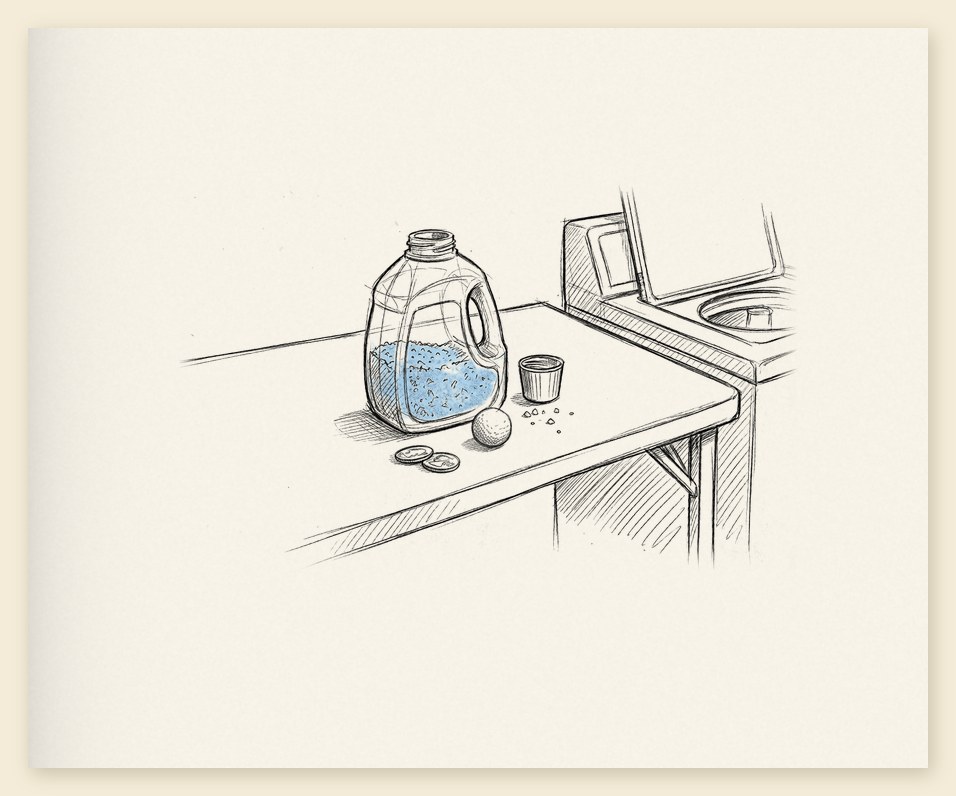
From a back pocket came a wallet, thin and small and worn, and he slid it into the back pocket of the windowpane jeans. From the other back pocket came the envelope, and it went into the other one. Then a golf ball and a handful of change, and they hit the counter together. The ball rolled off the edge, but he caught it before it hit the linoleum. He looked at her and held it up a little, with a nod. She was still laying in her layers.
The ball went in his left front pocket. He palmed the change and slid all of it but two quarters into the right.
The fatigues went back in. He looked into the washer. Then around the room. There was a vending machine on the far wall with single boxes of detergent behind the glass, and he started that way.
“Excuse me,” she said. “You can use some of mine. It’s better for colors. And it’s phosphate free. Those, I’m not too sure about.”
She held up the bottle. Fresh Start.
He came over.
“Oh. Thanks. I sorta forgot.”
“Sure. It happens. One cap should do.”
He took it back to the open washer. He filled the cap, poured the blue crystals in over the clothes, and looked at her. Maybe more? She had been watching him load. She nodded, and held up two fingers with almost nothing between them. A pinch.
Out on the street the bus engine turned over and caught.
He closed the lid. He slid the two quarters off the counter, dropped them in the slots, and pushed the slide home. He stood there and listened until the washer started to fill.
The bus idled. Then the pop and hiss of the brakes, and it rumbled away.
He brought the bottle back to her.
“Hey. Thanks again.”
“Glad to help. It’s really good detergent. That shirt’s going to look nice.”
They looked at each other.
“Well, okay,” Carl said. “Thanks again. I need to get going. Bus to catch.”
She watched him go to the door and out. He stopped on the sidewalk and looked across the street.
He looked left. He looked right. He looked left again, nodded that way, and strode.
She finished her loading. She measured the detergent into each machine, dropped the lids, and fed in the coins. She reorganized the baskets. She picked up her book and went to the front of the room and took a bright blue molded plastic chair by the windows.
She looked at the cover before she opened it. A Confederacy of Dunces. She had been hoping for a copy since she read Henry Kisor’s review in the Sun-Times in June.
She was well into a chapter when Carl’s washer went quiet.
She let it sit. The laundromat was the only door open on the street on a Sunday — coin machines, no attendant, a sign with the hours. When her own two finished she moved all three loads to the dryers. She folded his with hers. At five she was out the door with two baskets. His clothes were in one of them.
Later that evening, after a good deal of walking, Carl had the town roughly down. A hotel with a faded sign — the Cambridge Hotel, established 1885, and looking like it. A general store. He could tell through the big front windows it was the real thing, cabbage to wheelbarrows. It was closed. Almost everything was closed. The laundromat had been the exception, and that was earlier. The town was quiet save the bakery cart at the corner of two streets, where a young man with freckles and curly red hair was packing up for the day, and people coming and going from a few restaurants. Quietly, most places. Not at Clark’s Pizzeria. Clark’s had a crowd inside and another one out on the sidewalk — it was summer, after all — mostly recent high school graduates, squeezing out their last month at the top of the food chain.
A hawk led him to a water tower. The water tower led him to the Jerome B. Rice Seed Company, a massive complex of buildings that looked mostly closed. Near it, set back off Main, was a gazebo. Eight sides. He looked at the benches. He picked one and sat. Then he lay down along it to test. He fit. Barely.
After a while, he slept.

