
CAMBRIDGE, NEW YORK — JULY 1980
Brother Robert brought the Courier down the track into the holler a little after five in the morning. The sky had been lightening since he left the monastery, black going over to gray in the east, but the light hadn’t reached the bottom of the holler yet. The trees around the clearing were still black against the sky, and the cabin was a darker shape at the edge of them. He stopped short of it and turned the key off.
The clipboard rode on the dash. The top sheet was Tuesday. Under it was a sheet that was not a list, not properly. Loose notes. Carl, and Basil. He kept it there in case something came to him during the day that he wanted to get down.
He took the thermos off the seat and the lunchbox off the floor. The lunchbox was a workman’s tin. The thermos was too big to go in it.
The upper half of the door stood open against the wall. The lower half was shut. He went to it carefully and looked in over it.
It was quiet inside, and dark. The window let in a little gray, and with him standing in the doorway the door let in less.
Something grumbled — short, and down low along the floor. Then a longer one. Then one longer than that.
He waited for his eyes. The floor came first, then the newspaper in front of the door, then the rug. The sound had come from the middle of the room, where the rug was. Penny, likely.
He opened the lower half and stepped in, and set the lunchbox and the thermos on the counter, and crouched low by the door. He kept his voice down.
“Penny.”
He could make her out now, coming toward him off the rug, slow. Then he heard her nails on the boards. He made a note to check them and trim them.
She came to him. He said hello and gave her the back of one hand to smell, and then the other. Then he petted her, and without thinking about it his hands went on from petting — the ears, the paws, up under the chin. She looked at him. She seemed to like it, for a little while. Then her head started working against his hands, trying to get around him, to see out the door.
She needed to go out. He stood up and stepped aside.
She went out onto the stoop, stopped, looked around, and stepped down off it and went right. Robert came out behind her, pulled the lower half shut, and latched it. He stood at the edge of the stoop. She went along nose down to the edge of the woods and did her business.
“Penny.”
Nothing. She’d had the name one night. He had thought she might come to it anyway, more or less. She didn’t.
He stepped down and went after her. She was working the edge of the clearing, nose down, tail up. There was white starting in the feathering along the back of the tail, and it showed in the gray light. Give it a few months and it would show from across a field. He let her read the paper. For a pup her age, it was the Sunday edition. She was going around the clearing in order. They had gone most of the way around it when he heard the lower half of the door bang against the siding.
Carl was out on the stoop, stretching and yawning. JJ and Emmy came out past his legs at a race and went off the stoop into the gravel and dirt, a soft crash each, and got themselves upright and squatted where they were. Birdie came out after them. Carl turned and looked back in through the door.
“Come on, Slim. Breakfast after business.” A wave.
Slim came out. Carl stepped down and went off to the right toward the trees, and Birdie and Slim went with him. At the treeline he picked a tree, and all three of them did their business.
Robert had watched all of it. He looked down. Penny was beside him, watching too. He waved her on and started across toward Carl, and she came along at his side.
They met in front of the cabin. Good mornings went around. The pups collected around Carl, playing. JJ and Emmy came over and jumped on Robert’s legs a little. Penny stayed where she was, next to him.
“How’d it go last night?”
“Good.”
“Yes.” Robert looked them over. “All accounted for. I brought you some breakfast. Let’s go in. I’ll take care of theirs while you eat.”
Inside, Carl pulled the cup off the top of the thermos, unscrewed the stopper, and poured. Robert lit the lamp. He filled two bowls with chow and topped off the water from the jug.
Carl tried the coffee — a sip — and then put the rest of the cup down in three or four swallows, looked into the bottom of it, and poured again. He was still standing at the counter when he opened the lunchbox. Two English muffins in foil, toasted, a thick slice of ham in each. He ate the way he drank: a test bite, then half the muffin at once.
The pups ate the same way. They skipped the test.
So much for going over the day at breakfast. Every mouth in the room was busy. Robert waited as long as he could.
“Think you can extend the slumber party till lunch or so? The septic people are supposed to come back this morning, and after that I’ll probably be covering the phone.”
“Sure. We can find some things to do. Need to tucker these guys out.”
“What?”
“Tucker ’em out. Before I go to LL’s.” Carl looked down at the bowls. “Well — need to stop and get supplies first. Unless you’re going to stay with ’em.”
Robert ran it both ways. He could not stay with them himself, not today. Keeping Carl home meant telling LL something, and he did not want to make something up for her. He looked for a third way and didn’t find one.
“Yes. Well — no. I’ll be back around noon, and we’ll head into town. I’ll check my lists. I’m sure there’s something we need.” He looked at the pups. “They’ll probably want a nap pretty soon. Get them up around ten or so and keep them moving. Tucker them out. I’ve got to get back. Anything you need?”
Carl looked around the room.
“Got everything we need.”
Robert went out to the truck.
—
Brother Robert came back down the track a little before noon.
Carl was across the clearing with the pups, at the foot of the mound by the trees. Robert started to go through their names again, to check himself, and looked at his watch instead. He left the truck where the track came in and walked over.
Carl took two or three long strides up the mound and squatted at the top. A few of the pups needed no encouragement. He had been holding one of them back before he started — Emmy — and she beat him to the top. A couple of the others were slower, and they got some “Come on” and some “You can do it.” At the top they all got a word from him. Then they came down, rolling and stumbling, and Carl came down after them and met them at the bottom.
“Way to go. How many’s that?”
Some of them looked more interested in the question than others.
Carl looked at Emmy. “M, you got a few more in ya, I think. Optional for the rest of you.”
He stood to start up, and she was off — up the mound and down the other side, around in a wide U-turn that threw pebbles and bits of the patchy grass, and across the clearing to Robert before Carl reached the top. Robert squatted to pet her. Birdie came over to him as well.
Carl and the rest stepped over.
“Hills, huh?” Robert looked at it again. “Mounds, anyway.”
“Yeah. But not for goofing off.”
“My town list grew this morning. We’ll need to split up if we’re going to get it all done and not leave these guys alone too long. I’ll drop you at the general store, and pick you up at LL’s — quarter past five, about.”
Carl nodded. The pups had scattered some by then.
“Let’s round them up and get them in.”
Robert was still talking when Carl called Penny and waved her toward the cabin — follow me — and she followed the instruction. He called a few more times, waving, and the rest of them saw him and saw Penny, and followed Carl and Penny inside.
Robert hustled to catch up.
Inside, Penny sat down in the middle of the room. The others assembled around her. The mound had taken some of the run out of them. It was not a military assembly, but it was a start.
“I’ve got to go into town and take care of some varmints. You remember, right? The mission,” Carl told them. “Won’t take long. Stay out of trouble.”
He took a hammer down off the wall, got a nail out of a coffee can and a scrap of wood off a shelf, and went over to the hole in the open corner. He set the board over it and tapped the nail in.
“And stay away from this hole. That’s my job when I get back.”
The pups looked at him.
“I can’t hear you.” He cupped a hand to one ear.
The pups went on looking at him.
“Got it? Okay, you knuckleheads. See you later.”
At the truck, Brother Robert realized he had been waiting for the pups to answer too.
The counter man was reorganizing the shelves on the wall behind the counter when the bells on the door went, and went again as it closed.
A man stood three or four steps inside with a basket already in his hand. His feet stayed planted. His upper body did the turning while he looked the place over. He was unfamiliar in more than the usual ways.
“Need some help? Just about anything you can name, we’ve got it under one roof.”
“Yeah.” The man kept looking around.
Then nothing, until the bells went again and an older man came in. He had to step around the one standing there. He didn’t, really, but he made a point of it, and he gave the counter man a look about it. The man got a look too, from the boots up as far as the shirt. Then he went off to the right and toward the back.
“Got a project you’re working on? Maybe I can point you in the right direction.”
The man was still looking around. He took a step to the left and looked up at the aisle signs. “Well. Some varmints. Garden.”
“End of aisle fifteen, back right corner. Some on the end cap, and some outside in the garden area.”
The man went the other way, to the produce along the left wall.
The older man came back and put a box of gopher gassers on the counter. The counter man knew him. He knew to keep it short, unless he wanted to hear the latest thing that was wrong with Cambridge, or the State, or the world. He rang up the box and kept it short.
Fifteen or twenty minutes later the man came to the counter with the basket full. A can of Charles Chips. A jar of pickles. A few mason jars. The rest was small — a good many little envelopes from the bulk bins, the cheapest mortar and pestle the store carried, and produce, loose, for the scale. Some of it barely moved the needle.
The counter man rang it up without comment and bagged it in one of the double-thick sacks. He watched the man, arms full, stride to the door and open it, the bells clanging and the sounds of Main Street coming in with them, and step out. Then the door closed and it was quiet. He went back to his shelves.
Reed was nineteen, and it was his first summer running the King Bakery cart. He had it on the corner across from the laundromat, by the light. Business was slow. It would pick up — people wanting something sweet after lunch, and some bread buyers.
A man walking toward the cart passed the sandwich board, stopped, and turned back to read it. Reed gave him a little room before he said anything.
“Any questions?” Nobody had one. “The fritters are still good. Couple of the fried ones, too. They won’t be for long.”
The man had his arms full — a sack in one, a can of chips in the other.
“No thanks.”
Then horns, out in the intersection between them and the laundromat. They both looked. The man had to turn around to do it. More horn, and a couple of hands out of the windows with a finger up, not pointed at anything in particular, unless it was the sky. Somebody yelled something, and somebody yelled something back. None of it was friendly. It broke up as fast as it had started.
The man was still looking across the street at the laundromat. He stood there about half a minute. Then he went on the way he’d been going.
LL had her tea on the front porch and two stacks of folders: the one she had started with, going down, and the one she had been building beside it, going up. The Historical Society’s was the last of the first. She had just closed the village budget — the thick one — and set it on the second, and picked up the Historical Society’s, when Carl caught her eye, coming along West Main with a grocery sack in one arm and a can of Charles Chips in the other.
His boots were open, the laces dangling. She had a moment’s concern about that.
She got up and met him at the sidewalk, at the edge of her property.
“Hello, Carl. Here, let me take one of those. You didn’t walk all the way from the monastery?”
She got the can, after a little tussle over it.
“Oh, no. Robert dropped me off at the store. Needed some supplies.”
“Did you get everything you need?”
He had nothing with him that looked like a garden tool.
“There’s a tool shed out back. Every kind of garden tool from the last hundred years. There are a few in there I still haven’t figured out.”
“Yeah, thanks.” His eyes were over her shoulder, on the gardens.
“Well. Let’s let you get to work.” She started him toward the back. “And I expect a bill. For your time. And your supplies.”
At the back she said, “I’ll leave you to it. Anything you need, just knock and come in.”
She set the can on a step at the back door and went in, through the kitchen and up the center hall to the front porch, and collected her folders and her tea and brought them back to the kitchen. She set them on the table and went to the sink.
The kitchen window gave onto the beds.
He had found an old board, wide white pine, and set it across a corner of the fence for a table. On it were a mortar and pestle, a number of small envelopes, and some mason jars. He walked the wire first, the whole run of it, slow. Then the beds. Twice he stopped working altogether — once at the phlox, a long time, his face down in it, and once at the corner post, at nothing she could see.
The water came on at the outside spigot. There was the bang, and the rush of it through the pipes. She’d had plumbers out over the years, several, and not one of them had fixed it for good. She looked out at the man in her garden.
She checked on him from the window, on and off, for most of the afternoon.
Later in the afternoon he stood at the gate and swung it a few inches each way, and she knew what he had found. The gate had a catch in it, a small bind partway through the swing. She felt it every time she opened it. She had been feeling it for a year.
Around four she thought he was finishing, and was wrong. At a quarter to five she was wrong again. Just past five the board was back in the shed and everything was back in the sack, and she went for it. She had tea. She had shortbread from yesterday. She opened the back door.
He was at the gate with his back to her, working it through the bind, back and forth, just enough. Then he knelt at the top hinge. He took a small spade out of his back pocket and used it to push the hinge pin up and out, and looked the pin over, and looked around, and found the knot hole in the corner post. He set the pin into the hole partway and pulled on it, bending it. Pulled it out. Sighted along it. He did it once more, the same way, and this time it satisfied him. He seated the pin back in the hinge and swung the gate through where the bind had been.
He stood and turned. She was maybe ten feet off, and had been for a while, and was suddenly aware of how that might look. Neither of them said anything for a moment.
“All done,” Carl said. “Well — almost. If you’ve got some 3-in-One, I can take care of the rest. With the hinges.”
“Oh — thank you, Carl. I think I can handle that, though. I’ve got some WD-40 in the garage.”
Something changed in his face at WD-40. She understood why when he answered.
“Well. WD-40. Good stuff. It’s got its purposes.” He looked at the hinge. “It’s mostly solvent. Gets in there and pushes the water out — that’s what it’s for. Then the solvent flashes off, and what’s left is a film about as thick as nothing, and the dust sticks to that. Month later you’re right back where you started. On a hinge you want an oil. Three-in-One’s a machine oil. Light. It’ll creep down around the pin and stay there.”
She did her best to listen. She couldn’t help looking past him, at the beds. It might nudge him off the subject. It did. He turned to see what she was looking at.
“So,” she said. “My furry friends. I know these things don’t happen overnight — but when do you suppose I’ll start seeing the end of them?”
“Special recipe I’ve been working on. Actually doesn’t taste too bad. The varmints don’t like it, though. Only thing is, it may take three or four rounds. So, yeah. Not overnight.” He looked at the beds himself. “I’ll come by in a day or two for the next one.”
Doesn’t taste too bad. She wanted to ask. She had already had an earful about the WD-40.
“Well then. I’ll be patient, thank you. Now, what can I do for you? I’m sure you’re thirsty. It’s getting close to dinner — maybe a snack, to hold you over?”
Carl took a look up toward the sun. “Robert should be coming by in about twenty. But yeah — some water. Tea, maybe, would be nice too. Snacks I’ve got covered.” He nodded at the sack by the fence, then at the chips can on the step. “But hey — another thing. Can I borrow this spade for a day or two? Came in handy today. Might come in handy tomorrow.” He pulled it out of his pocket.
“Certainly. That’s what it’s there for, isn’t it?”
“Let’s go inside,” she said. “We need to settle up, too.”
He slid the spade back into his pocket and picked up the sack, and followed her through the back door. She brought the chips can in.
—
She sat him at the breakfast table by the window and went to work. Two glasses came down from the cabinet in one hand. Napkins came off the short stack at the center of the table and went down with a small slap. She took the glass pitcher out of the icebox and poured.
“Meaghan’s cider tea,” she said, setting his glass down.
Carl had the pickle jar out of the sack and open before she finished. He dug out a spear and took a crunch while he held the jar out to her. She took a spear and bit it.
“Oh — you found some crispy limes.”
Carl drank — a swallow, then most of the glass. She drank too, and refilled his glass.
“So. What do I owe you?”
Carl looked at her and rolled his head a little, and looked out the window at the garden.
“No. You’ve been out there four hours. And the supplies?”
“Not much. Don’t worry about it.”
She was not going to stand for that. She found the sack and dug out the receipt — a long tape of small figures, and not much at the bottom of it. She ran the numbers on her way to the counter, took her change purse out, counted out some bills, and folded them. She held them out. Carl leaned back in his chair, away from them. She pushed them further toward him.
“No arguments. That covers your supplies, and your time today. Including your walk from the store.”
He took the folded bills and slid them into his front pocket without looking at them.
The knock came from the front of the house. Knuckles on the door frame, twice.
—
She excused herself and went up the hall. Robert stood behind the screen. The main door had been standing open since morning.
“Hello, Robert. Nice to see you.”
He gave it back with a bit of rush on it. “Afternoon, LL. Have you seen Carl?” — with half a look past her shoulder as he asked.
“Oh, yes. In the kitchen — please, join us.”
He followed her back.
“I’ll get you a glass — if you have the time.”
“No — no, thank you, LL. It’s been a busy week. I may have told you already — Basil and some of the brothers are away, and it looks to be getting busier. I’m afraid Carl and I need to get back.” He put a nod on the end of it, at Carl.
Carl was already turning the lid down tight on the pickles. He dropped the jar in the sack and came up with the sack. He nodded.
She walked them up the hall to the front. Carl went slow. He read the walls going — the photographs, the shallow wall case — and Robert reached the door a fair way ahead of him. Meaghan was on the porch, looking down, reaching for the handle of the screen when Robert opened it. She looked up, surprised.
Meaghan said hello to all of them, there in the foyer. Carl had stopped at the end of the hall, where it opened into the foyer, in front of a photograph — LL’s grandfather and three other men, on a green. Robert said they were just leaving and was sorry for it. He looked at Carl.
“Carl. Time to go.”
They went out the front door, and it closed behind them.
LL was turning back down the hall when it came to her. The chips. She went. Meaghan went past her at a good clip, through the kitchen and out the back door, and LL heard her on the back steps going down and then on the carriage house steps going up. LL picked the can up off the kitchen table and went out the back behind her.
“Hold on!” The men were nearly to the truck. They stopped.
“Hold on for me too!” Meaghan called from the top of the carriage house steps.
LL went to the truck and handed Robert the can. He looked at it a second and put it in the bed.
They had to wait a bit. Robert got in the truck.
Meaghan came back down the carriage house steps with a bag.
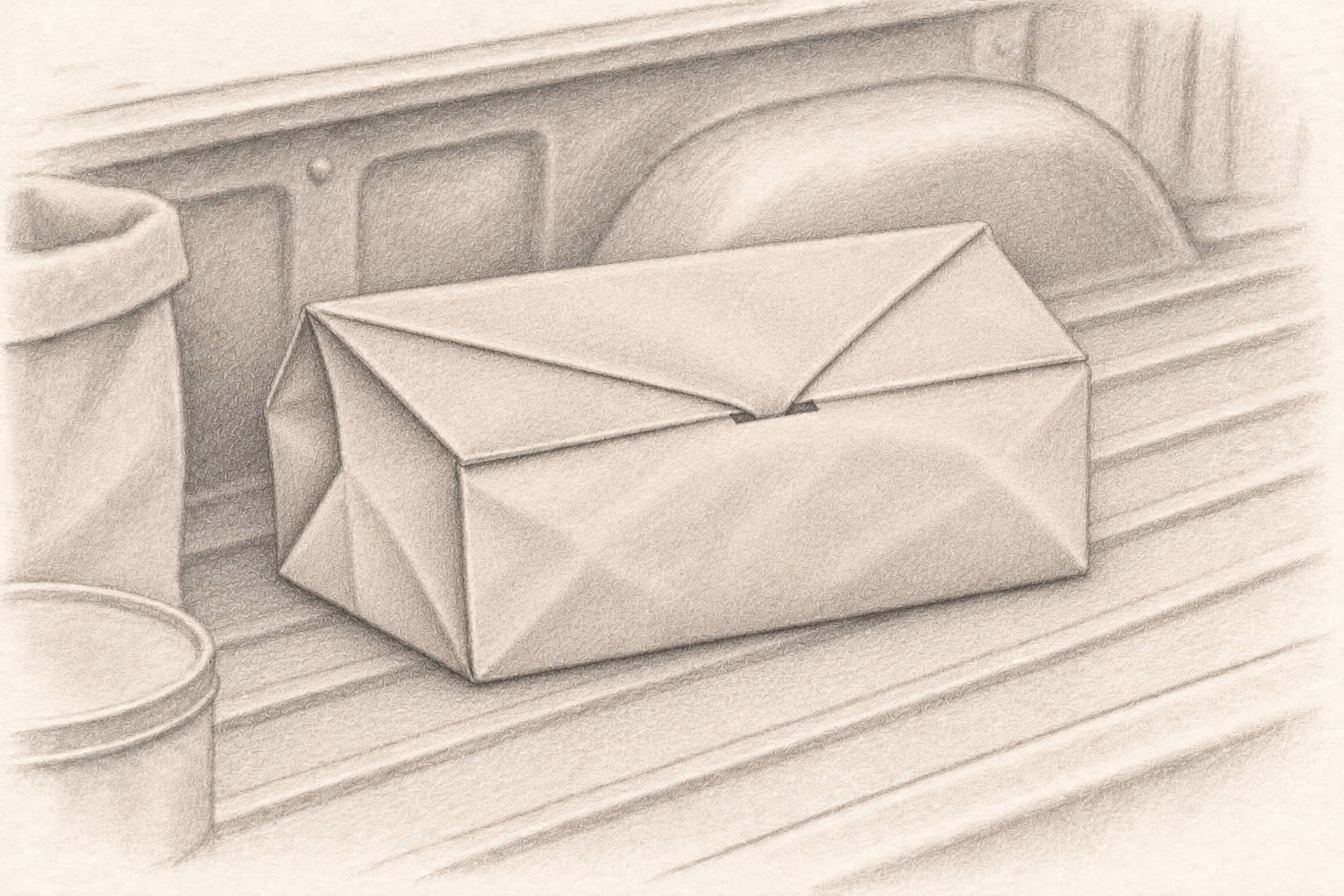
It was a funny-looking thing — not a store bag, not a gift bag, just a paper sack that had been folded down and creased and tucked into itself in a way that had clearly taken some doing, the corners squared, the top folded over twice and pressed flat. Something between a parcel and a present. The effort showed. Nobody said anything about it.
“Here,” she said.
Carl took it. He did not open it. He turned it once in his hands, and then he reached over the side of the Courier and set it down in the bed, next to the sack and the chips can, without ceremony.
“Thanks,” he said.
They looked at each other. Neither of them said anything. Then Robert turned the engine over, and the four-cylinder caught, and Carl got in.
Robert put the truck in gear. Meaghan stood in the drive and watched the yellow long-bed turn out onto the road, and then she went back up the carriage house steps, and did not examine, any more closely than she had to, why she’d folded a paper sack four times to make it look like that.
Robert had barely got the key out when Carl was out of the truck and headed for the cabin. Short of the door he stopped, came back to the bed, and started grabbing things. The bag from Meaghan was on top, and he had it.
Robert was in a hurry himself. He got out.
“You go let them out. I’ll get this stuff.”
He picked things out of the bed with one eye on the door. Carl opened the lower half, and the pups met him at the threshold. He stepped inside, went down to the floor with the bag, and rolled onto his back.
Robert brought the sack and the chips can to the door and set them down just inside, on the floor, and stayed in the doorway.
The newspaper in front of the door was dry. He looked over the rest of the floor and didn’t find anything there either. Five pups, shut in since noon. They would need to go out, and soon. He didn’t expect their luck to hold.
Carl started working the folds open. The pups decided this was a job for everyone. Slim got hold of a corner and hauled backward with his whole chunky body, and the paper tore away and left him with a scrap hanging out of his mouth, and then the scrap stuck to his tongue while he tried to spit it out. Birdie and Emmy were working their way into Carl, noses first, into the creases and folds of him.
The paper came apart in stages, more or less along the folds, backward. It put Robert in mind of the paper fortune-tellers kids used to fold. The pups undid about as much of it as Carl did, and then it was open.
Clothes. A madras shirt, white and blue and orange, patchwork, and a pair of green fatigues, washed, and folded as square as the bag had been.
Carl held the shirt up. JJ jumped for it.
Carl looked at the shirt for a while.
Then he put the clothes up on the top bunk, out of the pups’ reach. The pups complained about it.
Robert had watched all of it, and he had questions — a few too many at once. He looked at his watch. Then back at the floor. His head shook, once, on its own.
“I’ve got to go, Carl. I need to check on the septic business. I’ll try to swing back by later if I can.” He stopped. “You good with another sleepover tonight?”
Carl was on his back with the pups, still talking to them. Robert caught “another party tonight” in it, and took that for an answer.
He stepped out onto the stoop. The newspaper inside the door caught his eye, still dry, and he stopped and turned around.
“Let those guys out. But give me a minute or two to get up the track.”

