
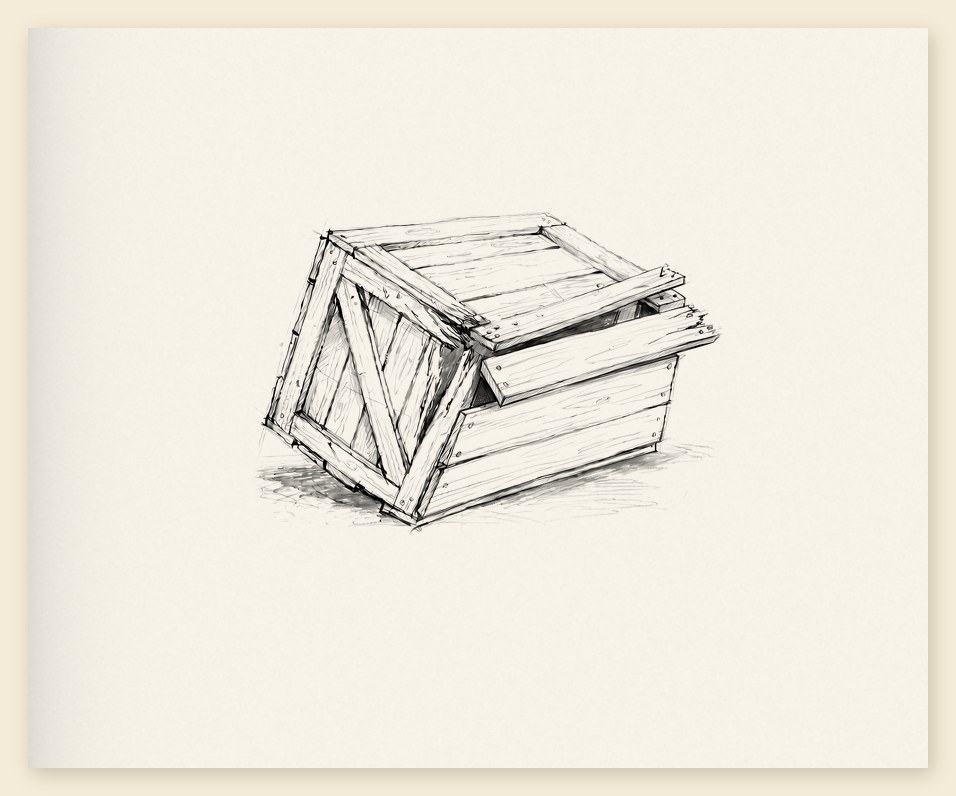
CAPE GIRARDEAU, MISSOURI — APRIL 1970
Verdell was in the pilothouse running his list. The forklift worked outside below and he could follow it without looking: the engine coming up under a load, the hydraulic whine at the stack, the fall to idle where the ramp plates began, up again on the flat. He had hired the lift and the men with it off the dock that morning, flat rate for the job, the way you hired in Cape Girardeau, and he had already gone down once to tell them to slow it down. The pace had been climbing again since. He shook his head, muttered something, and went back to his list, still tuned to the loop of the forklift outside.
Then the loop broke. Silence.
He finished the line he was on. Then he looked up, ducked through the pilothouse door, and stepped out toward where the forklift ought to be.
It was there. A long crate still sat on the forks. Two smaller crates were on the ground, and they weren’t cubes anymore. Corners stove in, panels sprung. Some of the men were standing and looking at them. A few weren’t — they were in the mess, trying to salvage it, and one of those was forcing a crate lid down and losing.
Verdell went down.
He could not have said the name of one man he’d hired that morning, but he knew the faces, and the kid who stepped in at one of the busted crates wasn’t one of them. The kid got a hand under the lid, moved something inside until it sat the way it had been packed to sit, and brought the top down flush. He put his hand out for the hammer and the rigger gave it to him. He set a few nails in his lips and went to work.
Verdell’s own two deckhands were still aft on the boat, where he’d kept them on prep all morning. His crew was generally competent, but he was a man down. He was behind.
The first crate was sound before the lift came for it. The second one wasn’t going to be. It was the worse of the two — racked out of square, one panel split, no telling what had let go inside.
Verdell walked over. “My crew gets this wreck aboard,” he said. “You fix what needs fixing on the way down. You ever been downriver? No? Every man ought to run the river once. And this ain’t a free ride. It’s a paid ride.”
The kid looked at the crate. “Well, she looks pretty bad. Might have some internal injuries too. May take a while — how much time can you give me?”
“Plenty of time for fixing,” Verdell said. “Three squares and parts of the river you didn’t know existed.”
Then he walked to the forklift and told the operator, “You’re done.”
They ran the afternoon down. At dark Verdell put the tow against the bank and tied off — he didn’t run nights a man down — and the engines went to quiet, and he could hear the river again. The kid had been on the barge deck with the bad crate most of the day. From the wheel Verdell had watched him when the river allowed it: panels off, panels on, long stretches where nothing seemed to be happening at all. By the time the light was going, the crate stood square again, and Verdell, not sure of what he was seeing, went down to the barge.
“Should be good,” the kid said. “She sat back on her skids all right.”
Verdell looked at the crate.
“Gin stand’s riding in the long one, should be,” the kid went on, and pointed around the deck as he named them. “Feeder’s in this one here — she goes on top of the stand. Condenser inside that one. Flue sections in the two skinny ones, and the drive’s in the flat box. Somebody’s ginning cotton where this is headed. Or wanting to, anyway.”
The manifest was on the clipboard in the pilothouse. Verdell had read it twice at the pickup. The kid had it right down to the make.
He was still talking. The ribs were the thing on a gin stand, he said. A drop springs the ribs, and sprung ribs rub the saws, and then she chokes, or worse. The stand rode the forks and never hit the ground, but he’d pull a side panel and look anyway, if Verdell wanted.
Verdell wasn’t listening much. What was in him was relief, and he didn’t care to interrupt it. He said all right. Then he went back up to the pilothouse, and he took the feeling with him the whole way.
On the fifth day they made New Orleans on the money.
The forwarder’s wharf had a crane and men who knew how to use it. The receiving clerk worked the crates against the manifest, crate by crate, and signed, and Verdell tore his sheet out of the stack. Received in apparent good order.
For a second he thought about what might be bent inside, or worse. Then he thought about where the crates were going. They wouldn’t be cracked open again until they were on the other side of the world, and he was as American-proud as any man, but he’d moved freight long enough to know there were men in small countries over there who had been proving for some time that improvising wasn’t an American invention. If something in there was bent, a man or two with that kind of hands would rig a solution. Either way it didn’t matter now. He had a signature.
The relief came back. He called his crew of three together and laid out the evening. He didn’t call it a celebration. He’d been in tight spots before and he’d crossed the line, mostly, every time, and he’d never celebrated once — a man acted like he’d been there before. Which he had. A bar, on him, nothing crazy. Pushing off in the morning.
They walked up from the wharf into the Quarter and Verdell took them to the Old Absinthe House, because if a man was buying one round it might as well be bought somewhere worth standing in. He bought the round and told them that was the one he was buying, and that the boat pushed off early, and to take it easy.
The two deckhands got to work on theirs. The kid held his under his nose a while. Then he rattled the ice, held the glass up to the bulb over the bar, and looked through it before he committed to more than a sip.
Verdell stayed long enough to be sociable and not a minute past it, and walked back to the boat alone.
First light, the diesels already turning over, Verdell went forward to the bunk cabin. Pip and Perry were snoring in the near bunks. The far bunk looked empty.
“Wake up. Time to head back up.”
He crossed to the far bunk and flipped the blanket and the pillow. Nobody. A folded piece of paper stuck up between the frame and the mattress.
He pulled it and unfolded it while the grunts and groans started behind him, and somebody cleared a snotty throat. Notepad paper, medium stock. A printed logo ran across the top: SPACKLER PLASTER AND WALL BOARD. Under the logo, handwritten, was the name of the supply house that sat just down the dock from where they’d loaded in Cape Girardeau. Under that, a list of supplies. And under the list, double-underlined: Be back by 11.
“Daylight’s burning.” Then: “Where’s Carl?”
Nobody knew where Carl was.
Verdell was on a schedule. He was always on a schedule, and this one had the usual amount of slack in it, which was none. He sent Perry, the more reliable of the two, up to the Absinthe House. “There. Look in and around it. Five minutes, no more, and straight back.”
Then he was in the pilothouse with the diesels idling and Pip standing on the bow line, and Perry came back down the wharf alone.
Verdell considered it for less than a minute. He had been fishing for good hands his whole life, every dock, every season. This was one that didn’t land in the boat. Maybe a good one. Better than average, sure.
He leaned out and called it.
“Throw ’em loose.”

